Buying guide · Products
Whole Egg Powder Buying Guide
Selection, functionality, specification review and procurement for the food industry's general-purpose egg ingredient.
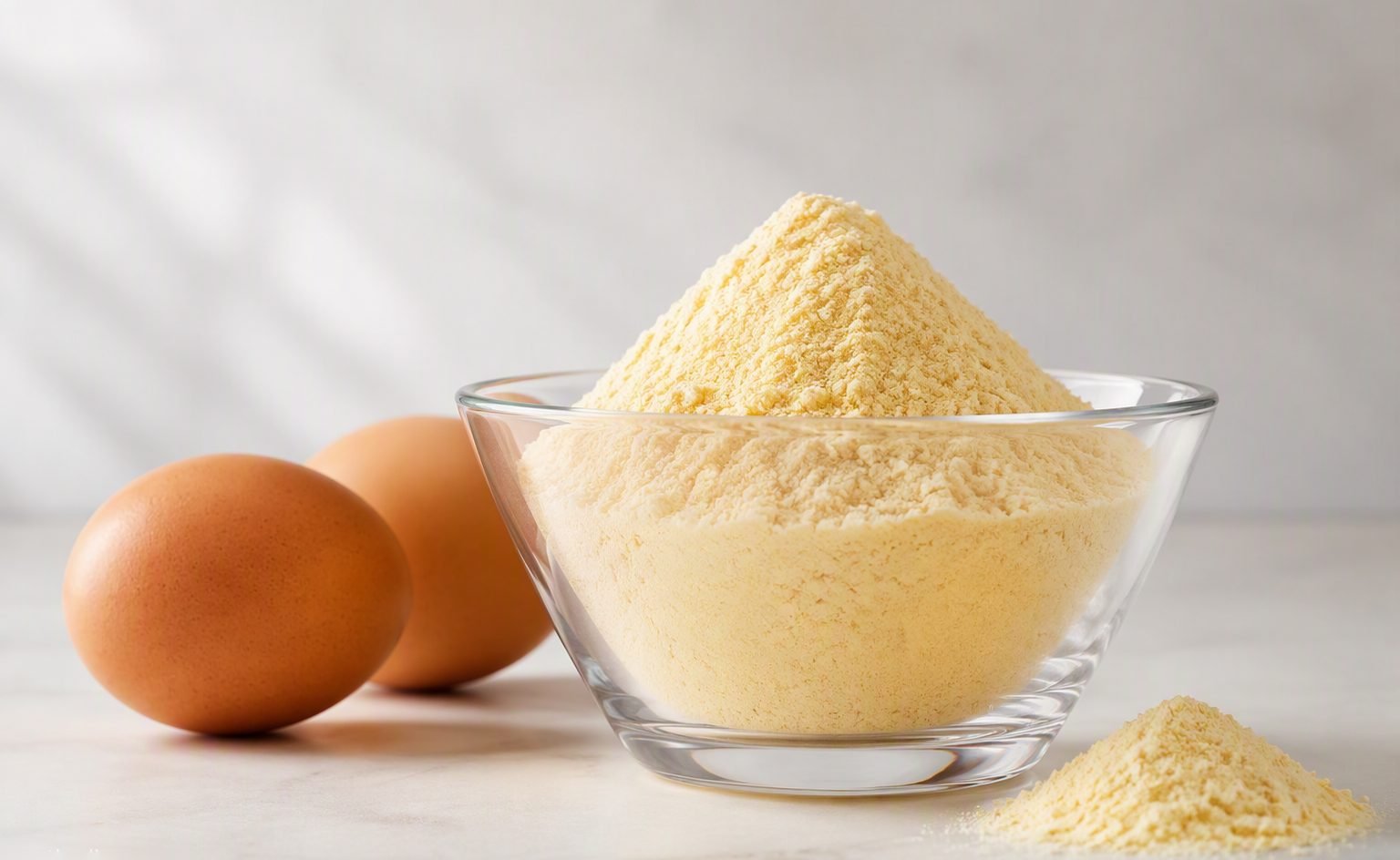
Scope of this guide
This is the product-specific buying guide for whole egg powder. It assumes the general purchasing method in the complete egg powder buying guide and goes deeper on the decisions specific to this product. For commercial scope and sourcing detail, see the whole egg powder product page.
Product selection: when whole egg powder is the right choice
Whole egg powder contains both the white and the yolk of the egg in their natural proportions, dried together. Choose it when your formulation uses whole egg today, or when you want balanced functionality — the gelling and binding of the white combined with the emulsification, richness and colour of the yolk — without managing two separate ingredients. If your process depends on high-volume stable foam (white) or maximum emulsifying power (yolk), the separated products are usually the better tool; see the egg white and egg yolk buying guides for those decisions.
Typical applications
Whole egg powder is the general-purpose egg ingredient across food manufacturing:
- Bakery — breads, buns, cakes, muffins and premixes, where it contributes structure, moisture retention and colour. See bakery industry and baking applications.
- Biscuits and cookies — dough binding and consistent spread; biscuit applications.
- Noodles and pasta — dough strength and colour; pasta & noodles industry.
- Mayonnaise-style and emulsified products — where yolk-heavy whole egg or blends are used; compare mayonnaise applications.
- General food processing — batters, coatings, ready mixes and institutional catering; food processing and institutional buyers.
Application lists are orientation, not guarantees: your formulation determines whether whole egg powder performs as needed, which is why application trials are non-negotiable.
Functionality to specify and test
Whole egg powder is bought for what it does. The functional properties most buyers actually test are: solubility and reconstitution behaviour (how cleanly it hydrates), gelling and coagulation on heating (structure in baked and cooked products), emulsification support (the yolk fraction), foaming contribution (limited compared with pure albumen), and colour and flavour contribution. Decide which of these are critical for your product, have them reflected in the specification where measurable, and test the rest in application trials. Reconstitution practice is covered in how to use egg powder.
Specifications: what to review
Review the whole egg powder specification section by section: identity and ingredient declaration (it should be egg, nothing unexplained), physical characteristics (appearance, colour, odour, solubility), chemical parameters (moisture, protein, fat as a minimum), microbiological criteria, allergen declaration, storage and shelf-life statements, packaging and regulatory information. Our specification guide explains each section and the difference between typical values and guaranteed limits. Sahya Agro's current whole egg powder specification: [WHOLE EGG POWDER SPECIFICATION TO BE CONFIRMED] — request the document; do not buy from a summary.
Quality and COA
Qualify on the specification, then accept each delivery on the certificate of analysis. The COA should identify the batch, mirror the specification's parameters, and show actual results against acceptance criteria. The COA guide walks through verification line by line; our documentation policy is at Quality — COA and Quality — Testing. Batch identity on the packs, the COA and the shipping documents must match — that is what keeps the delivery traceable; see Quality — Traceability.
Procurement: MOQ, samples and terms
Structure the purchase in three stages. Stage one: document exchange — specification, sample COA, certification and licensing evidence (our status: certification policy). Stage two: sampling — production-representative samples tested in your application. Stage three: commercial terms — MOQ ([ACTUAL MOQ]), lead time, Incoterms, payment terms and remaining-shelf-life-on-arrival guarantees. Production-scale buyers can also review the bulk egg powder supply page for volumes, documentation and logistics. Price enters seriously only after stages one and two pass.
Packaging and storage
Whole egg powder is more oxidation-sensitive than egg white powder because of its fat content — packaging barrier quality matters more, not less. Confirm the moisture barrier, pack integrity, batch coding and palletisation before the first order; Sahya Agro formats: [PACKAGING FORMAT TO BE CONFIRMED]. Storage follows the standard discipline — dry conditions, intact packaging, rotation, careful opened-pack handling — detailed in the storage guide and the packaging guide. Shelf life is product- and packaging-specific: [PRODUCT-SPECIFIC SHELF LIFE TO BE CONFIRMED].
Logistics and import
Ambient shipping is a core advantage, but transit time still consumes shelf life: for sea freight, align order cycles and confirm minimum remaining shelf life on arrival. Importing adds the standard document chain — invoice, packing list, certificate of origin, health/sanitary documents where required — covered in the import-export guide, with market specifics on our Global Supply pages. Verify destination requirements with the relevant authority or your importer.
Supplier evaluation for whole egg powder
Apply the five-lens framework from the supplier evaluation guide with two whole-egg-specific emphases: batch-to-batch consistency of colour and flavour (the most visible variability in this product), and reconstitution performance in your process water and mixing conditions. Ask every candidate supplier how they manage both, and let application trials arbitrate the answers.
Practical takeaways
- Buy the function. Whole egg powder is the balanced choice; if you need maximum foam or maximum emulsification, look at the separated products.
- Specification is the contract. Review every section, and hold [WHOLE EGG POWDER SPECIFICATION TO BE CONFIRMED] values as document requests, not assumptions.
- Fat content changes the risk profile. Barrier packaging and storage discipline matter more for whole egg powder than for albumen.
- Trial before terms. Documents, then samples, then price — in that order, every time.
Answers
Whole egg powder FAQ
Bakery and premixes, biscuits, noodles and pasta, batters and coatings, ready mixes and general food processing — anywhere the complete functionality of whole egg is needed in a stable, consistently dosable format. Your formulation decides suitability; validate with application trials.
The same egg fractions, dried. Powder stores and ships at ambient conditions, keeps longer, and doses by weight; liquid requires refrigeration and has a short shelf life but needs no reconstitution step. The powder-vs-fresh guide covers the format trade-offs in detail.
When emulsification is the dominant requirement — mayonnaise and sauce production are the classic cases — or when you want yolk richness without additional white solids. The egg yolk powder buying guide covers that decision.
Identity and ingredients, physical characteristics, chemical parameters (moisture, protein, fat as a minimum), microbiological criteria, allergen declaration, storage and shelf life, packaging and regulatory information. Sahya Agro's current values: [WHOLE EGG POWDER SPECIFICATION TO BE CONFIRMED].
Match the COA batch code to the packs, verify each result against its acceptance criterion, inspect packaging integrity, and hold-and-query any mismatch. The COA guide gives the line-by-line method.
It contains the white fraction, so it foams — but high-volume stable foam is the specialty of egg white powder, not whole egg powder. If whipping performance is critical to your product, evaluate egg white powder or a blend in trials.
Current formats are [PACKAGING FORMAT TO BE CONFIRMED] — confirm format, size, barrier properties and palletisation during the RFQ rather than assuming from general industry practice.
Dry conditions, intact packaging, stock rotation and careful resealing after opening. Because of its fat content, whole egg powder is more sensitive to oxidation than albumen, so packaging integrity matters more. Exact conditions are product-specific: see the specification and storage guide.
It depends on the destination's rules for egg products, which vary and change. Our import-export guide explains the document chain and links to published market pages; always verify current requirements with the destination authority or your importer.
Work with us
Specify it. Sample it. Then judge us.
Request the current whole egg powder specification and a production-representative sample.