Whole Egg Powder for Industrial Food Production
The complete functionality of fresh egg — binding, emulsification, colour and richness — in a shelf-stable powder built for bakeries, biscuit plants, sauce makers and food manufacturers.
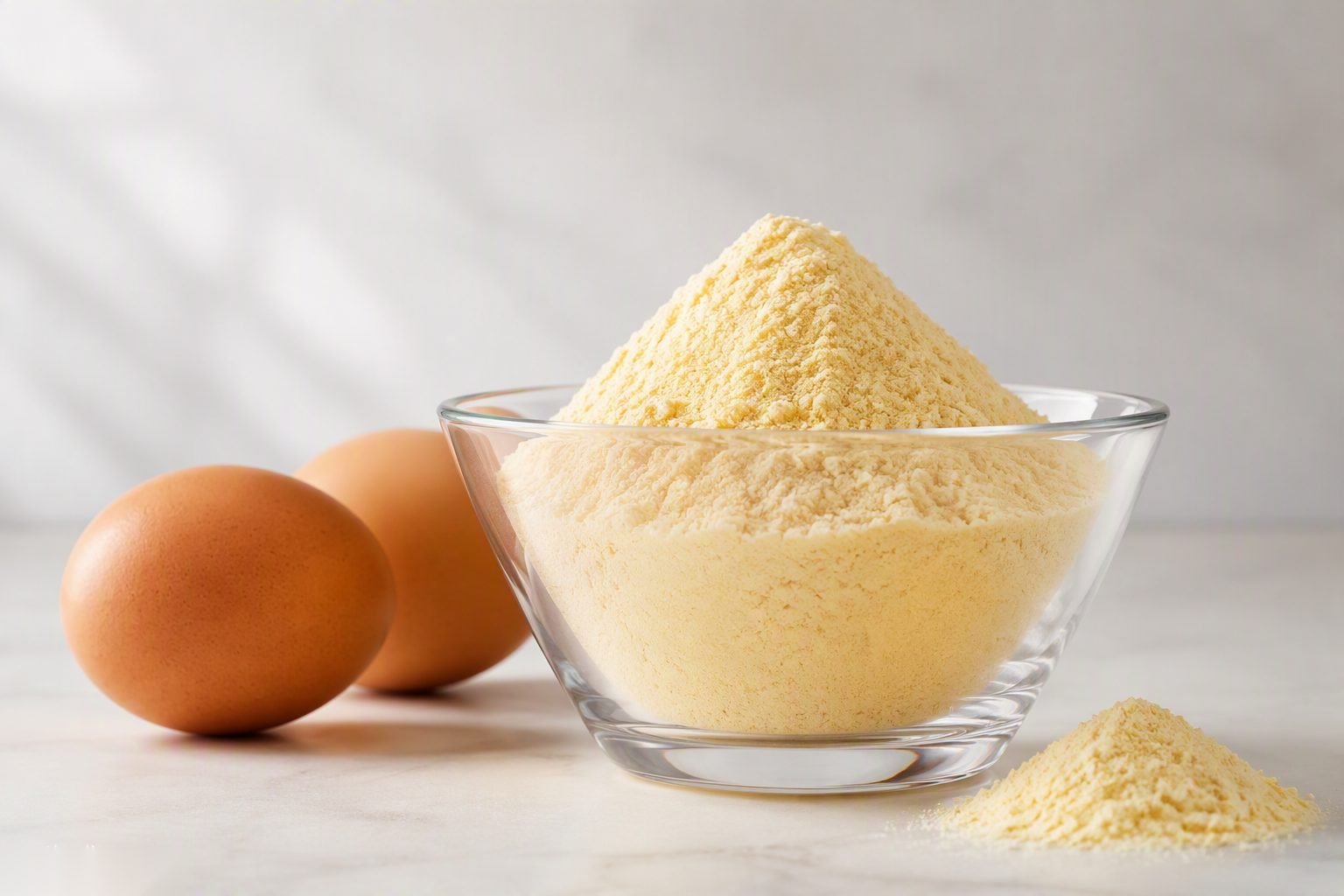
What is whole egg powder?
Whole egg powder is fresh whole egg — white and yolk together — that has been pasteurised and dried into a fine, free-flowing powder. It contains the natural balance of egg protein, fat, lecithin, vitamins and pigments found in shell eggs, but in a format that stores at ambient-friendly conditions, weighs a fraction of the original liquid, and doses cleanly into industrial mixers. For food manufacturers, it removes the three biggest headaches of shell eggs: breakage, cold-chain dependence and variable supply.
In practical terms, whole egg powder is the general-purpose workhorse of the egg ingredient world. Where egg white powder is chosen for whipping and egg yolk powder for emulsification, whole egg powder is chosen when a formulation needs everything egg does at once: structure from the proteins, richness from the lipids, golden colour from the carotenoids and the characteristic flavour consumers recognise as "made with real egg."
The functions behind that performance — binding, structure and emulsification support — are mapped in egg powder functional properties.
Why manufacturers switch from shell eggs to powder
Procurement teams rarely switch formats for a single reason — the case is cumulative. Powder eliminates shell and membrane waste, cuts refrigerated storage requirements, standardises composition from batch to batch, and simplifies both inventory planning and hygiene management. A dry ingredient also slots directly into dry-mix production lines, something liquid egg simply cannot do. For exporters and distant buyers, powder turns a fragile, perishable commodity into a freight-friendly industrial ingredient.
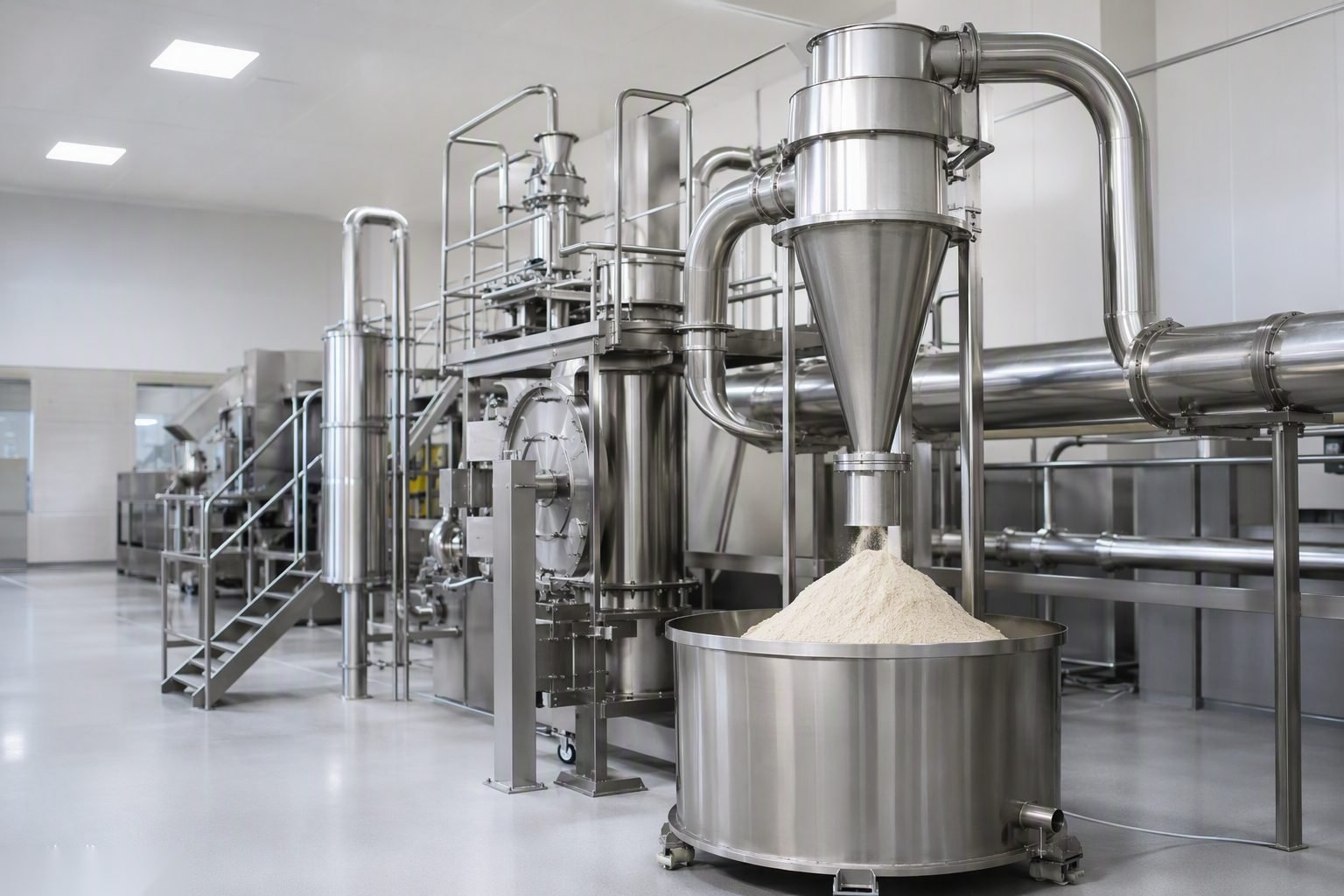
How whole egg powder is produced
The journey from shell egg to powder is a controlled sequence rather than a single step. Fresh eggs are collected and inspected, then broken and homogenised into a uniform liquid. The liquid egg is pasteurised — a food-safety step that protects the final ingredient — and then dried, most commonly by spray drying, where fine droplets meet hot air and lose their moisture in seconds, emerging as a fine powder. The powder is sifted, tested, and sealed into moisture-protective packaging.
Each stage exists for a reason: homogenisation guarantees that every gram of powder carries the same white-to-yolk ratio; pasteurisation addresses microbiological safety; rapid, gentle drying protects functional proteins so the powder still behaves like egg in your batter or sauce.
Food safety in egg powder production is systemic, not a single kill-step. Raw material intake control, hygienic zoning between raw and pasteurised areas, validated pasteurisation, environmental monitoring, metal detection and retained batch samples all work together so that every dispatched lot is documented and defensible. Our quality page describes this framework in more detail; specific process validations are marked [PROCESS DETAIL TO BE CONFIRMED] pending verified facility documentation.
Sahya Agro note: detailed process parameters — pasteurisation curves, dryer specifications, line capacity — are currently marked [PROCESS DETAIL TO BE CONFIRMED] and will be documented with verified facility data before detailed claims are published.
Whole egg powder vs fresh eggs
The comparison that matters to a production manager is not powder versus shell egg in the abstract — it is total cost and risk per unit of egg functionality delivered to the mixer. Fresh eggs carry hidden costs: breaking labour, shell disposal, refrigerated storage, spoilage risk, seasonal price swings and microbiological exposure. Powder converts those variables into a stable, documented input. In return, manufacturers accept one extra step — rehydration or process-water adjustment — and a sensory profile that, in well-formulated products, is functionally equivalent for baked and processed applications.
Functional properties that matter in production
Whole egg powder earns its place in formulations through a bundle of functionalities:
- Binding & structure — egg proteins coagulate with heat, giving baked goods, pasta and formed products their set and crumb.
- Emulsification — yolk lecithin stabilises oil-in-water systems such as mayonnaise, dressings and cream sauces.
- Colour & appearance — natural carotenoids deliver the golden crumb and rich surface consumers expect from egg-based recipes.
- Flavour & richness — yolk lipids round out flavour in biscuits, cakes, brioche-style doughs and fillings.
- Moisture & tenderness — egg solids help retain softness and extend perceived freshness in baked goods.
- Nutritional contribution — egg contributes high-quality protein and natural micronutrients to finished products.
Because powder is homogeneous, these functionalities arrive in identical proportion batch after batch — the consistency that industrial recipes depend on. [ACTUAL PRODUCT SPECIFICATION] values for protein, fat and moisture will be published on the technical data sheet once confirmed.
The nutritional contribution of egg
Egg is one of the most nutritionally complete ingredients a food formulator can use. Its protein is the reference standard against which other protein sources are scored for quality, containing all essential amino acids in proportions the human body uses efficiently. The yolk fraction contributes fat-soluble vitamins, choline and natural carotenoids, and the whole egg delivers these nutrients in a form consumers already trust and recognise on an ingredient list. For manufacturers, this matters commercially as well as nutritionally: "egg" on a label signals real, recognisable food — a claim increasingly valuable as buyers and regulators scrutinise long additive lists. Where a formulation needs egg's nutrition without its fat — sports nutrition and high-protein products, for example — egg white powder is the specialist tool; whole egg powder is the choice when the complete nutritional and sensory package is the goal. Confirmed nutritional values for Sahya Agro whole egg powder will publish with the specification sheet [SPECIFICATION TO BE CONFIRMED].
How to use whole egg powder in production
Whole egg powder enters a formulation in one of two ways, and the right choice depends on your line rather than the ingredient.
Route 1: rehydration before use
For applications that expect liquid egg — sponge batters, mayonnaise bases, sauces — the powder is blended with water to restore a pourable, liquid-egg consistency before it joins the recipe. Good dispersion matters more than speed: add powder to water gradually with agitation rather than dumping water onto powder, allow a brief hydration rest, and avoid high-shear aeration that whips unwanted foam into the mix. The exact rehydration ratio for Sahya Agro whole egg powder is confirmed with the technical data sheet [SPECIFICATION TO BE CONFIRMED], because optimal water addition varies with the solids level of the specific product.
Route 2: direct dry dosing
In dry-mix manufacturing, biscuit doughs, pasta blending and bakery premixes, powder is scaled directly with the flour-side ingredients and the process water is adjusted to compensate. This route eliminates a process step entirely and is one of powder's biggest operational advantages: no breaking room, no refrigerated liquid handling, no egg-shell waste stream. Technologists reformulating from shell egg should account for the water that fresh egg would have contributed — the powder delivers the solids, so the missing liquid returns to the recipe as metered water.
Practical handling notes
- Keep it dry until use — powder is hygroscopic; opened bags should be resealed and used promptly.
- Avoid hot-water shock — very hot water can set egg proteins prematurely; hydrate at ambient or lukewarm temperatures unless the recipe specifies otherwise.
- Sift lumpy product — occasional soft lumps from storage humidity disperse easily and do not indicate spoilage; hard caking suggests moisture ingress and the lot should be checked.
- Validate in pilot trials — as with any format change, run bench or pilot batches before full-line conversion; our team supports dosage and rehydration questions during evaluation.
Applications: where whole egg powder works hardest
Whole egg powder shows up in more categories than almost any other single ingredient. Here is what it does in each — and what production teams should keep in mind.
Bakery: breads, cakes, muffins and brioche
In bakery, whole egg powder builds structure, enriches crumb and deepens colour. In cakes and muffins it supports aeration alongside chemical leavening and sets a tender, moist crumb; in enriched breads and brioche-style doughs it delivers the richness and golden hue these products are sold on. Dry dosing fits naturally into flour-side scaling, and because powder adds no water, hydration stays fully under the technologist's control. See how we work with industrial bakeries and the baking applications guide.
Biscuits, cookies and crackers
Biscuit doughs are low-moisture systems where liquid egg complicates hydration balance — powder solves this neatly. Whole egg powder contributes binding, spread control and surface colour in cookies, and supports the crisp, clean bite of crackers and wafers. For wire-cut and rotary-moulded lines, consistent egg solids mean consistent dough rheology shift after shift. More in our biscuit industry page.
Confectionery
In confectionery, whole egg powder appears in nougat, some fudge systems, baked confections and fillings where its protein structure and flavour support the matrix. Where pure foaming power is the goal, manufacturers usually reach for egg white powder instead — whole egg powder serves the richer, baked side of the category.
Mayonnaise and dressings
Mayonnaise is an emulsion, and egg is its classic emulsifier. Whole egg powder offers a convenient way to deliver both yolk lecithin and whole-egg flavour into mayonnaise and dressing systems, particularly in dry-mix and institutional formats. High-output mayonnaise lines chasing maximum emulsion strength often prefer the concentrated lecithin of egg yolk powder; whole egg powder suits recipes wanting a rounder, whole-egg profile. See the mayonnaise industry page.
Sauces, gravies and ready meals
In cream sauces, hollandaise-style systems, gravies and ready-meal components, whole egg powder thickens, emulsifies and enriches while surviving the thermal abuse of retort and hot-fill processing better than many fresh-egg workflows. It also simplifies dry sauce-mix manufacturing, where all ingredients must arrive shelf-stable.
Pasta and noodles
Egg pasta earns its name from egg solids. Whole egg powder gives pasta and noodle producers a standardised way to hit declared egg content with consistent colour and bite, without breaking rooms or liquid-egg cold chains on site. Dosing dry powder directly into semolina blending keeps the process clean and auditable — see pasta & noodles.
Food manufacturing and dry mixes
Cake mixes, pancake mixes, coating systems, dessert bases and soup powders all rely on ingredients that are stable, free-flowing and easy to scale by weight. Whole egg powder is one of the few protein-rich, functional ingredients that behaves this way, which is why it anchors so many consumer dry-mix formulations.
Foodservice and institutional catering
Central kitchens, hotel chains and institutional caterers use whole egg powder for scrambled-egg mixes, batters, bakery bases and sauce production where labour is scarce and consistency is everything. Portion-able dry product also reduces waste in kitchens with fluctuating demand.
Buying considerations for procurement teams
Choosing a whole egg powder supplier is a risk decision as much as a price decision. Buyers we speak with typically evaluate:
- Specification discipline — does the supplier commit to written specs, and does every batch ship against them?
- Documentation — COA per batch, clear product identity, and export papers that survive customs scrutiny.
- Traceability — can a complaint batch be traced back through processing to its source?
- Supply reliability — planned production and honest lead times, not optimistic promises.
- Technical backup — rehydration guidance, dosage support and formulation troubleshooting from people who understand the product.
- Logistics fit — packaging that protects powder integrity across your actual shipping route and climate.
Sahya Agro's commercial approach is built around these checkpoints: specifications on request, batch documentation, sample-first evaluation and direct access to our team. Commercial terms — pricing, MOQ [ACTUAL MOQ], lead time and Incoterms — are confirmed per enquiry because they depend on volume, packaging and destination.
Comparing formats before you commit? See all six egg ingredients side by side, or answer two quick questions in the product selector.
Quality considerations
Whole egg powder quality is judged on two axes: what you can measure and what you can verify. Measurable parameters — moisture, protein, fat, microbiological status — belong on the specification sheet and COA. Verifiable systems — pasteurisation control, hygienic zoning, metal detection, retained samples — belong in the supplier's quality documentation and, ideally, an audit.
Our quality pages describe the six disciplines we apply across the range: quality control, food safety, testing, hygiene, traceability and documentation. Certification claims remain marked [CERTIFICATION TO BE CONFIRMED] until verified documents are available — we would rather show you a placeholder than a fake badge.
Specification framework
Final values publish when the verified specification sheet is complete. The framework below shows exactly which data points your team will receive.
Buyer specification summary
| Product | Whole Egg Powder |
|---|---|
| Form | Powder |
| Application | Bakery, Biscuits, Cakes, Confectionery, Desserts, Pasta, and more |
| Packaging | [TO BE CONFIRMED] |
| Shelf Life | [TO BE CONFIRMED] |
| Storage | [TO BE CONFIRMED] |
| MOQ | [TO BE CONFIRMED] |
| COA | [AVAILABILITY TO BE CONFIRMED] |
Specifications are subject to product-specific documentation and customer requirements.
| Physical / Chemical | Value |
|---|---|
| Appearance | Fine, free-flowing powder [TO BE CONFIRMED] |
| Protein | [SPECIFICATION TO BE CONFIRMED] |
| Fat | [SPECIFICATION TO BE CONFIRMED] |
| Moisture | [SPECIFICATION TO BE CONFIRMED] |
| pH | [SPECIFICATION TO BE CONFIRMED] |
| Solubility / dispersibility | [SPECIFICATION TO BE CONFIRMED] |
| Microbiological / Compliance | Value |
|---|---|
| Total plate count | [SPECIFICATION TO BE CONFIRMED] |
| Salmonella | [SPECIFICATION TO BE CONFIRMED] |
| E. coli / coliforms | [SPECIFICATION TO BE CONFIRMED] |
| Allergen status | Contains egg [FULL MATRIX TBC] |
| Certifications | [CERTIFICATION TO BE CONFIRMED] |
| COA per batch | Yes — issued with dispatch |
Cool, dry, sealed
Store in a cool, dry warehouse in unopened packaging, away from moisture, direct heat and strong odours. Confirmed limits: [SPECIFICATION TO BE CONFIRMED].
Moisture-protective
Formats are being finalised — [ACTUAL PACKAGING]. Export-grade options planned for long routes and humid climates.
Freight-friendly
No cold chain required for the powder format. Container and pallet configurations confirmed per order — [TO BE CONFIRMED].
Export supply from India
India is one of the world's largest egg-producing countries, with a modern processing sector supplying egg ingredients to food manufacturers across Asia, the Middle East, Africa and beyond. For international buyers, whole egg powder is the most freight-friendly way to source Indian egg: no refrigerated containers, no shelf-life race against the shipping calendar, and straightforward dry-cargo handling at destination.
Sahya Agro prepares export orders with the documentation customs authorities and your QA team expect — product documentation, batch COA and shipping papers — and supports buyers through sample evaluation before any commercial commitment. Our current export market list is marked [ACTUAL EXPORT MARKETS] and will be published once verified; if your country is not yet on the list, ask — new destinations are assessed case by case.
Practical export questions — Incoterms, port of loading, pallet configuration, container loading and lead time — are confirmed per quotation because they depend on destination and volume. More detail is on our global supply page, or start directly with a quotation request.

Whole egg powder — buyer questions
Straight answers to the questions procurement and R&D teams ask most.
Whole egg powder is used as a shelf-stable egg ingredient in industrial food production — bakery, biscuits, confectionery, mayonnaise, sauces, pasta, noodles, ready meals and foodservice — wherever fresh egg functionality is needed without shell-egg handling.
Whole egg powder is typically blended with water to restore a liquid-egg consistency before use, or dosed directly into dry mixes where process water is added later. Exact rehydration ratios depend on the application and are confirmed with the product's technical documentation.
Egg powder production generally includes pasteurisation of the liquid egg before drying. The specific time-temperature process used for Sahya Agro product is being confirmed and will be published with verified facility data.
In most industrial formulations, yes — whole egg powder is designed to deliver the binding, emulsification, colour and richness of fresh egg. R&D teams typically validate dosage in pilot trials, adjusting for the water that powder removes from the system.
In a cool, dry environment in sealed packaging, away from moisture and strong odours. Confirmed storage temperature and humidity limits will be published on the technical data sheet.
Egg powders are valued for long shelf stability compared with shell eggs and liquid egg. The verified shelf life for Sahya Agro whole egg powder is to be confirmed and will appear on the product's technical data sheet.
Packaging formats are being finalised and will be confirmed with the product specification. Export-grade packaging options are planned for international buyers.
MOQ depends on packaging and destination and is confirmed per enquiry. Samples are available so technical teams can evaluate the product before a commercial order.
Yes — batch documentation including certificates of analysis is part of our quality approach, and shipping documentation is prepared for export orders.
Industrial bakeries, biscuit and confectionery manufacturers, mayonnaise and sauce producers, pasta and noodle plants, ready-meal processors, foodservice suppliers, ingredient distributors and importers.
Both start from the same raw material. Powder is dried for shelf stability and freight simplicity; liquid whole egg stays pourable for high-volume plants with chilled infrastructure. Powder suits dry mixes, long shipping routes and sites without cold chains; liquid suits continuous high-throughput lines nearby.
Yes — sample-first evaluation is our standard approach. Technical teams can test functionality in their own formulations before any commercial commitment. Request samples through the quotation form.
Need whole egg powder specs or a sample?
Share your application, volume and destination. We respond with specs, samples and pricing.
Need product specifications, documentation or a sample? Contact Sahya Agro directly: info@sahyaeggpowder.com · +91 8950846072 · WhatsApp