Procurement · Packaging
Egg Powder Packaging Guide
One job: keep a dry ingredient dry, clean and identifiable to your production line. Here is how to evaluate it.
Scope
This guide explains what egg powder packaging must achieve and the questions to settle before ordering. It describes industry practice, not a catalogue: Sahya Agro's current formats are [PACKAGING FORMAT TO BE CONFIRMED] — confirm in writing during the RFQ. Our own approach is at Quality — Packaging & Storage; warehouse-side handling is in the storage guide.
Moisture barrier
Egg powder's enemies start with moisture. Industry packaging therefore builds around barrier liners — sealed inner bags engineered to keep water vapour out — inside protective outer packaging. The barrier is what makes ambient shelf life possible; a premium product in a weak liner is a weak product. Ask any supplier what the barrier structure is and how seal integrity is controlled at packing. For the fat-rich whole-egg and yolk powders, the barrier also slows oxidation — barrier quality matters most exactly where the product is most sensitive.
Contamination protection
Packaging is also the foreign-matter defence: it keeps dust, pests and handling contamination away from the ingredient through warehousing, transport and dock handling. Food-contact materials should be appropriate for the purpose, and outer packaging should be robust enough that the inner liner is never the first thing the world touches. Your own receiving inspection closes the loop — damaged outer packaging is a reason to inspect the liner carefully, not just to note the carton.
Package integrity
Integrity means the pack arrives as sealed as it left: seams intact, closures sound, no punctures, no water damage. Specify in your purchase terms how packs should be presented and what happens when they are not — a clear damaged-goods protocol avoids arguments later. At receiving, treat integrity checks as part of acceptance, alongside the document verification in the COA guide.
Labelling
A B2B egg powder label should identify the product, the manufacturer, the batch or lot, production and best-before dating, net weight, and storage instruction consistent with the specification. Export labelling may add destination-specific requirements — confirm these during the order process for your market, as rules vary. If your operation needs specific label data (for example, your own item codes on outer cartons), raise it in the RFQ; labelling is routinely configurable in B2B supply.
Lot and batch identification
The batch code on the pack is the thread of traceability: it matches the COA, the shipping documents and the supplier's production records, and it is what lets a complaint be scoped to specific deliveries. Check at receiving that pack codes match the COA, protect labels in your warehouse, and record which batches feed which production runs. The system this plugs into is described at Quality — Traceability.
Palletisation
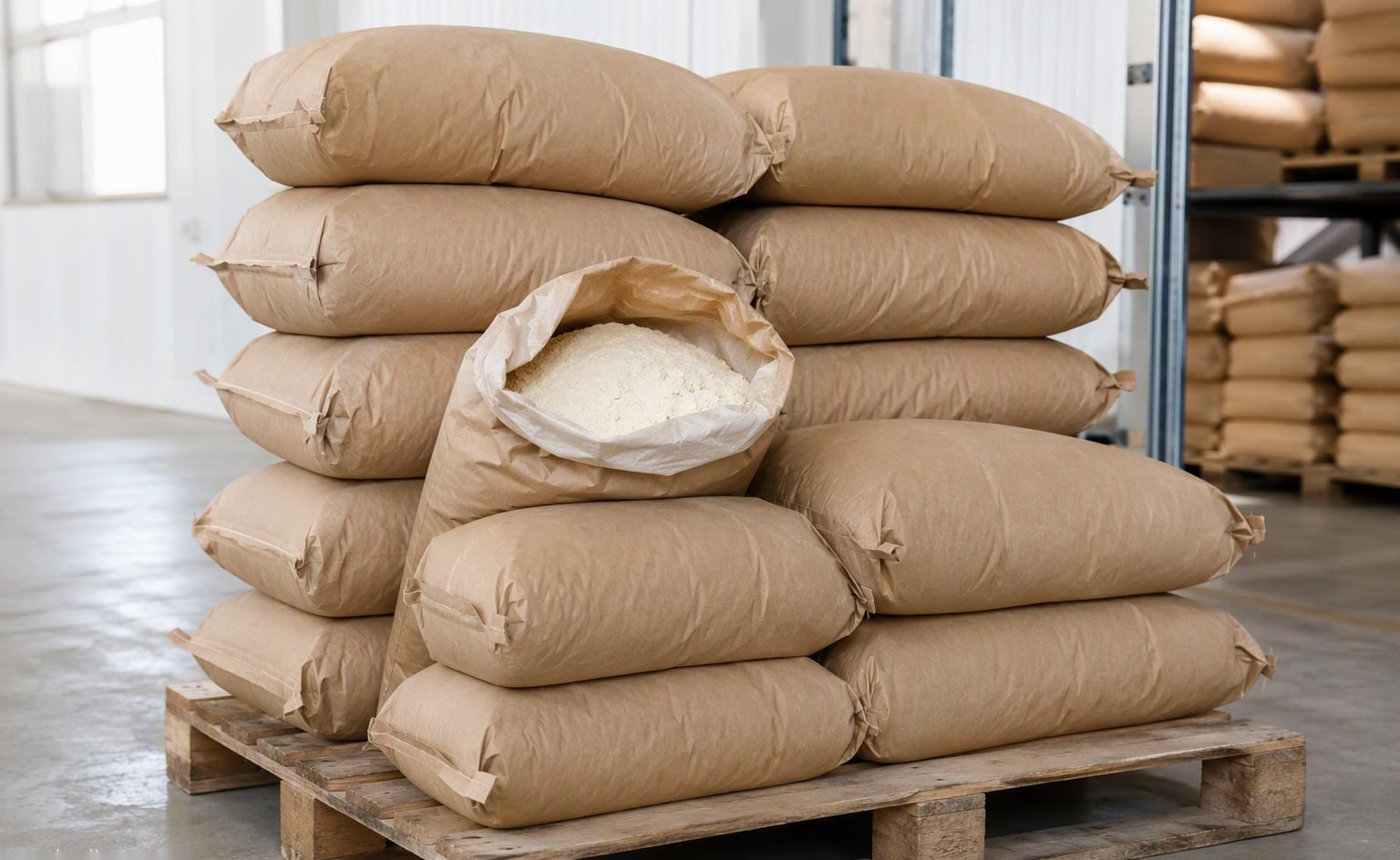
How packs are palletised determines whether they arrive intact: stacking pattern, pallet quality, wrap, corner protection and container loading all matter, especially on long sea routes. Confirm pallet configuration, stack limits and container-loading practice in the order process; photograph anything anomalous at receiving before breaking down pallets, so discussions with the supplier or insurer start from evidence.
Transport
Egg powder travels ambient — a major cost advantage — but ambient does not mean indifferent: keep pallets dry at docks, out of standing water and prolonged sun, and protected from weather during loading. For buyers, the transport questions to settle are mode, transit time and its effect on remaining shelf life — [PRODUCT-SPECIFIC SHELF LIFE TO BE CONFIRMED] — and who owns which leg under the agreed Incoterms.
Export considerations
Export adds destination requirements to packaging and labelling: some markets specify label content, language, or certification marks on documentation accompanying the packs. These requirements are destination-specific and change — verify with the destination authority or your importer, using the import-export guide and our published market pages as orientation. Export pack configurations: [PACKAGING FORMAT TO BE CONFIRMED].
Packaging questions for your next RFQ
- What pack formats and sizes are available for this product? (Sahya Agro: [PACKAGING FORMAT TO BE CONFIRMED])
- What is the barrier structure, and how is seal integrity controlled and checked?
- What appears on the label, and can buyer-specific data be added for our market?
- How is batch identification applied, and does it match the COA format?
- What is the pallet configuration, stack limit and container-loading practice?
- What is the damaged-goods protocol at receiving?
Practical takeaways
- Barrier is the product's bodyguard. Moisture barrier quality decides whether stated shelf life is achievable — ask what it is.
- The batch code is the thread. Pack code = COA = shipping documents; protect it through your warehouse.
- Confirm formats in writing. Pack sizes and configurations vary by manufacturer — [PACKAGING FORMAT TO BE CONFIRMED] until documented.
- Photograph before you break pallets. Receiving evidence settles transport questions fast.
Answers
Packaging FAQ
Around a moisture barrier: sealed inner liners engineered against water vapour, inside protective outer packaging, palletised for transport. Exact formats and sizes vary by manufacturer — Sahya Agro's are [PACKAGING FORMAT TO BE CONFIRMED]; confirm in the RFQ.
[PACKAGING FORMAT TO BE CONFIRMED]. We do not publish assumed sizes; current formats, sizes and pallet configurations are confirmed in writing during the quotation process.
Egg powder is hygroscopic — absorbed moisture degrades solubility, whipping and flow. The barrier liner is what makes ambient shelf life achievable, and for fat-rich yolk and whole-egg powders it also slows oxidation.
Product identity, manufacturer, batch/lot code, production and best-before dating, net weight and storage instructions consistent with the specification. Export markets may add destination-specific label requirements — verify for your market.
Pallet configuration, stacking pattern, wrap and container loading are confirmed per order. For long sea routes, palletisation quality determines whether packs arrive intact — raise it explicitly in the order process.
Photograph before breaking down the pallet, inspect the inner liner carefully, quarantine affected packs, and invoke the damaged-goods protocol agreed in your purchase terms. Damage to the barrier is a quality issue, not a cosmetic one.
No — ambient transport is a core advantage of the format. Protect pallets from weather and prolonged heat at docks, but refrigerated freight is not required under normal conditions defined by the specification.
Buyer-specific label data (item codes, market-specific content) is routinely configurable in B2B supply — raise it in the RFQ. Destination-mandatory label content is a regulatory matter to verify with the destination authority or your importer.
Work with us
Confirm formats before you commit.
Ask for current pack formats, barrier details and pallet configuration in your RFQ.