Egg Ingredients for Biscuit Manufacturers
Low-moisture doughs leave no room for liquid ingredients that behave unpredictably. Why the biscuit industry buys egg as a powder — and what to check before you do.
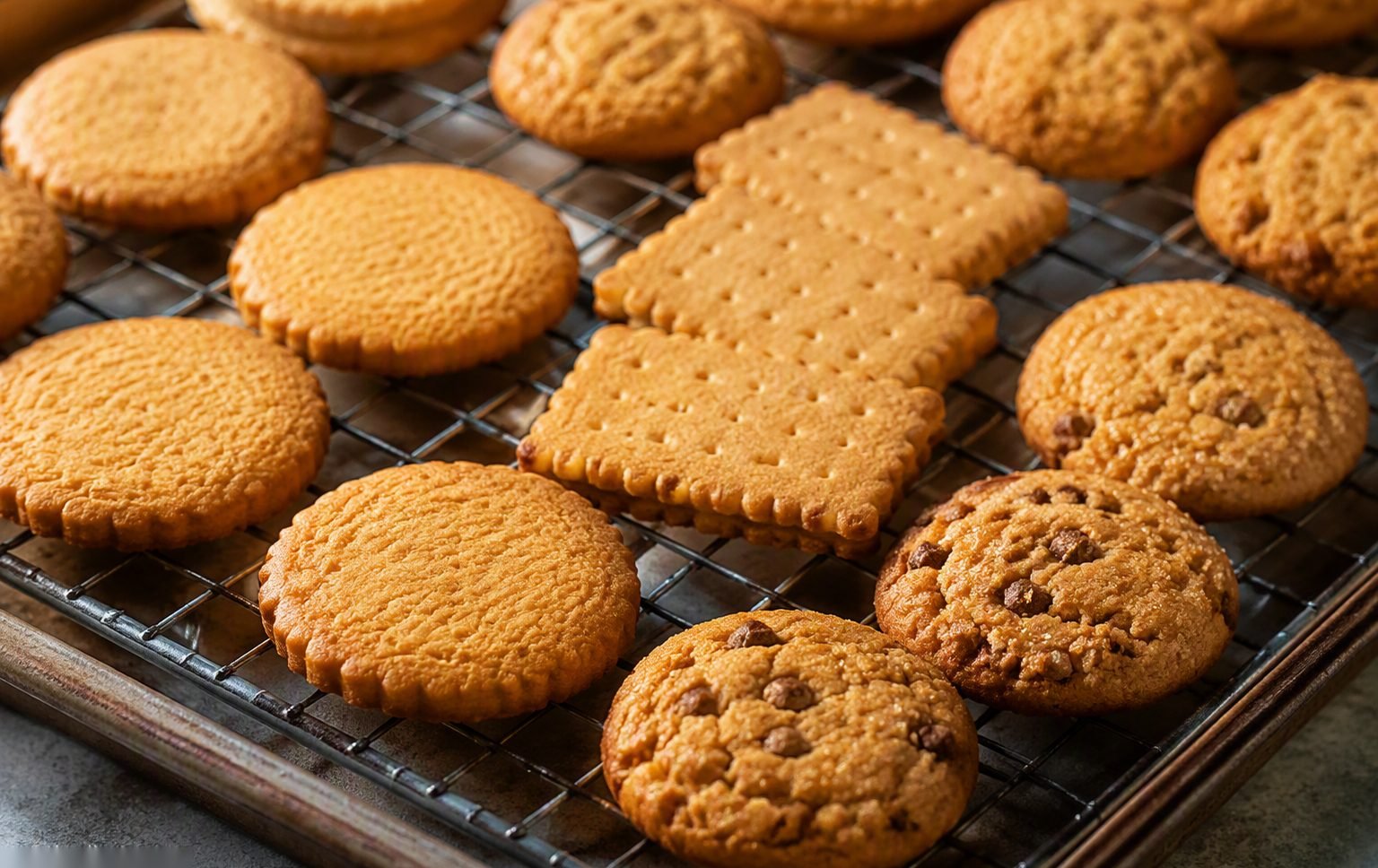
The biscuit industry's ingredient reality
Biscuit manufacturing is one of the most engineering-driven categories in food. Doughs are mixed to tight specifications, machined at thousands of pieces per minute on rotary moulders, wire-cut machines and sheeting lines, and baked in tunnel ovens where a few degrees shift the final product's colour, snap and moisture. Raw materials are bought on cost-in-use per tonne, and consistency is not a quality aspiration — it is the difference between a line that runs and a line that stops.
Egg enters this system as a functional minor ingredient with an outsized influence: a few percent of egg solids changes dough handling, spread, colour and flavour in ways consumers notice and line operators must manage. The industry's long-standing preference for egg powder over liquid or shell egg is not fashion — it is a direct consequence of how biscuit doughs work.
From Industry Requirement to RFQ
1 · Industry requirement
Typical need: binding and texture in biscuit and cookie doughs. Define your process conditions, volumes and destination before selecting an ingredient.
2 · Relevant egg ingredients
Potentially relevant ingredients for evaluation: Whole Egg Powder, Egg White Powder, Egg Yolk Powder. Final selection depends on formulation, process and customer requirements.
3 · Technical information
Review the buyer specification summary and the specification guide; product specifications are provided per product on request.
4 · RFQ
Share your requirement, destination and documentation needs through the RFQ form — or request a sample first.
Where egg ingredients fit in biscuit formulations
Biscuit doughs run at far lower moisture than bread or cake batters — hydration is a budget, and every gram of water is accounted for. Liquid egg is mostly water, so using it means removing water elsewhere and hoping the dough's behaviour survives the adjustment. Egg powder sidesteps the problem entirely: it scales with the flour-side ingredients, contributes its protein, fat and lecithin, and leaves the water balance exactly where the technologist set it.
Functionally, egg does four jobs in biscuits. Its proteins bind the dough and set during baking, holding shape and controlling spread. Yolk lipids and lecithin tenderise, giving short doughs their characteristic melt. Egg solids support browning, building the golden surfaces that signal a well-baked product. And yolk flavour rounds out rich recipes — the difference between a plain sweet biscuit and a butter-cookie style product.
Direct-answer: why do biscuit manufacturers consider egg powder?
Because it delivers egg's binding, colour and richness without touching the dough's hydration budget, stores without refrigeration in standard ingredient warehouses, and arrives with a batch-to-batch uniformity that keeps line settings stable — three things shell or liquid egg cannot offer a low-moisture dough system.
Sahya Agro products for biscuit production
Whole Egg Powder
The standard biscuit egg ingredient: binding, browning, flavour and balanced enrichment for cookies, semi-sweet biscuits and baked snacks.
View product → SpecialistEgg Yolk Powder
For rich short doughs and butter-style cookies where golden colour, tenderness and rich flavour define the product's premium position.
View product → SpecialistEgg White Powder
For low-fat crisp products and applications needing protein binding without added fat — and for glazes where gloss matters without colour.
View product →Application breakdown by biscuit type
Cookies and wire-cut products
Cookie doughs are the most egg-dependent biscuit systems: egg controls spread, binds inclusions, and delivers the soft-or-crisp texture the recipe targets. Chocolate-chip style products rely on egg's moisture-management during baking to keep centres soft while edges set. Powder dosing keeps dough consistency stable on wire-cut machines, where small rheology shifts show up immediately as weight and shape variation.
Short doughs and rotary-moulded biscuits
Shortbread-style and rotary-moulded products use yolk-rich egg for tenderness and colour. The fat-plus-lecithin contribution shortens gluten development and gives the clean, sandy bite these products are judged on. Egg yolk powder is the specialist tool here; whole egg powder covers balanced recipes.
Semi-sweet and hard sweet biscuits
In sheeted and cut semi-sweet lines, egg appears at lower inclusion rates where recipes use it — mainly for surface colour and flavour rounding. Consistency matters most: the same browning behaviour at the same oven settings, every day.
Crackers and wafers
Lean crackers use egg selectively, if at all; where used, it supports texture and colour. Wafer batters and cream fillings are a separate story — cream fillings commonly use egg-derived richness, and confectionery-style aerated systems apply to some wafer products. Egg white powder occasionally appears in low-fat crisp formulations.
Baked snacks
Savoury baked snacks use egg for binding seasoning systems and surface finish where recipes call for it — typically whole egg powder at modest inclusion, valued for dosing precision.
Functional considerations for biscuit technologists
- Moisture discipline — in low-moisture doughs, powder's lack of added water is its core advantage; verify powder moisture content on the spec, because it contributes to your dough's total.
- Dough rheology — egg proteins and lipids change mixing time, dough consistency and machining; standardised egg solids mean stable line settings.
- Spread and set — protein coagulation during baking controls final geometry; batch-consistent protein means batch-consistent spread ratios.
- Colour development — egg solids participate in browning; expect to re-tune oven profiles slightly when converting from liquid to powder at equal solids.
- Flavour — yolk lipids carry rich, baked flavour notes; premium short doughs should benchmark yolk powder against their current egg source in finished-product tasting.
- Dispersion — powder must disperse evenly through the flour side; standard premixing practice prevents localised concentration.
Powder vs fresh and liquid egg in biscuit production
For biscuit doughs specifically, powder is rarely a compromise — it is usually the technically preferred format, because it respects the hydration budget that defines the category. Liquid egg can still suit plants making soft-baked or cake-adjacent products at high volume with chilled infrastructure. Shell eggs belong to an earlier era of biscuit manufacturing: breaking labour, cold storage, variable composition and hygiene burden all argue against them at commercial scale. The honest caveat: converting to powder requires re-validating dough water addition and oven profile — a one-time R&D cost, not an ongoing penalty.
Procurement guide for biscuit buyers
- Cost-in-use — evaluate per tonne of finished biscuits, not per kilogram of ingredient; consistent dosing lowers true cost.
- Specification sheet — moisture, protein, fat and physical standards in writing; moisture matters most in low-moisture dough systems.
- COA per batch — verify against spec; agree micro parameters for your category.
- Supply reliability — biscuit lines run continuously; assess planned production, buffer-stock strategy and honest lead times [TO BE CONFIRMED].
- MOQ and packaging — [ACTUAL MOQ], [PACKAGING TO BE CONFIRMED]; match pack size to shift consumption to limit open-bag time.
- Documentation — batch identity, traceability, allergen declaration (contains egg), export papers where applicable.
Quality & food safety: what to evaluate
Beyond certificates, biscuit buyers should verify the disciplines that keep a dry ingredient safe and consistent: pasteurisation validation, hygienic drying and packing, metal detection, moisture control through the warehouse chain, retained samples and rapid batch documentation. Biscuit lines are unforgiving of variable ingredients — ask how the supplier demonstrates batch-to-batch uniformity.
Our approach is described on the quality page. Certifications remain [CERTIFICATION TO BE CONFIRMED] until verified documents are published.
Humidity-protective
[PACKAGING TO BE CONFIRMED] — formats will be recommended against your shift consumption so opened packs are used quickly.
Dry warehouse
Cool, dry, sealed storage with FIFO rotation — no refrigeration, but humidity control protects dosing accuracy.
Dry cargo
No cold chain; pallet and container configurations confirmed per order — [TO BE CONFIRMED].
Export considerations for biscuit manufacturers
Biscuit plants outside India source egg powder as dry cargo with batch COA and shipping documentation. Destination requirements — label declarations, import registration, food-authority notifications — should be raised at enquiry stage so paperwork is planned into lead time. Verified destination list: [ACTUAL EXPORT MARKETS]. See our global supply page.
Biscuit industry questions
Egg binds the dough, controls spread during baking, enriches short and soft doughs with fat and lecithin, supports surface browning and colour, and rounds out flavour. In rich cookies and shortbreads it is a defining ingredient; in lean crackers it is used more selectively.
Biscuit doughs are low-moisture systems with a tight hydration budget. Liquid egg adds water that must be compensated elsewhere, while powder doses dry with the flour and keeps hydration fully under the technologist's control. Powder also stores without refrigeration and scales precisely by weight.
Whole egg powder covers general cookies and semi-sweet biscuits. Egg yolk powder suits rich short doughs where colour and tenderness sell the product. Egg white powder appears in low-fat crisp products and specialised applications where binding without added fat is wanted.
Yes — egg proteins and lipids influence dough consistency, machining behaviour and baked texture. The advantage of powder is that this influence is identical batch after batch, which stabilises settings on rotary moulders, wire-cut machines and sheeting lines.
Egg solids participate in browning reactions during baking and yolk carotenoids add a warm golden tone, so egg powder contributes to the surface colour consumers associate with quality biscuits. Final colour always depends on the full recipe and bake profile.
A written specification, COA per batch, microbiological limits, moisture content (critical in low-moisture dough systems), packaging integrity against humidity, shelf life, and a sample trial on your own line before volume commitment.
Biscuit manufacturing is cost-sensitive and high-volume, so buyers evaluate cost-in-use per tonne of finished product, supply reliability and documentation discipline. Powder's long shelf life supports forward purchasing and buffer stock strategies that perishable egg formats cannot.
Cool, dry and sealed — standard dry-ingredient practice. Humidity control matters because caked powder affects dosing accuracy; opened packaging should be resealed and rotated first-in-first-out.
[ACTUAL MOQ] — MOQ depends on packaging and destination and is confirmed per enquiry. Samples are available so your technical team can validate the product on your own line first.
Yes — powder formats ship as dry cargo with batch COA and export documentation. Our verified export market list is to be confirmed; biscuit manufacturers are welcome to enquire about their destination.
Running biscuit lines? Let's talk egg solids.
Share your products, volumes and destination — we respond with specs, samples and pricing.