Using Egg Ingredients in Egg Pasta
Colour, flavour and dough character — what egg contributes to egg pasta, and how powder formats fit dry-ingredient production.
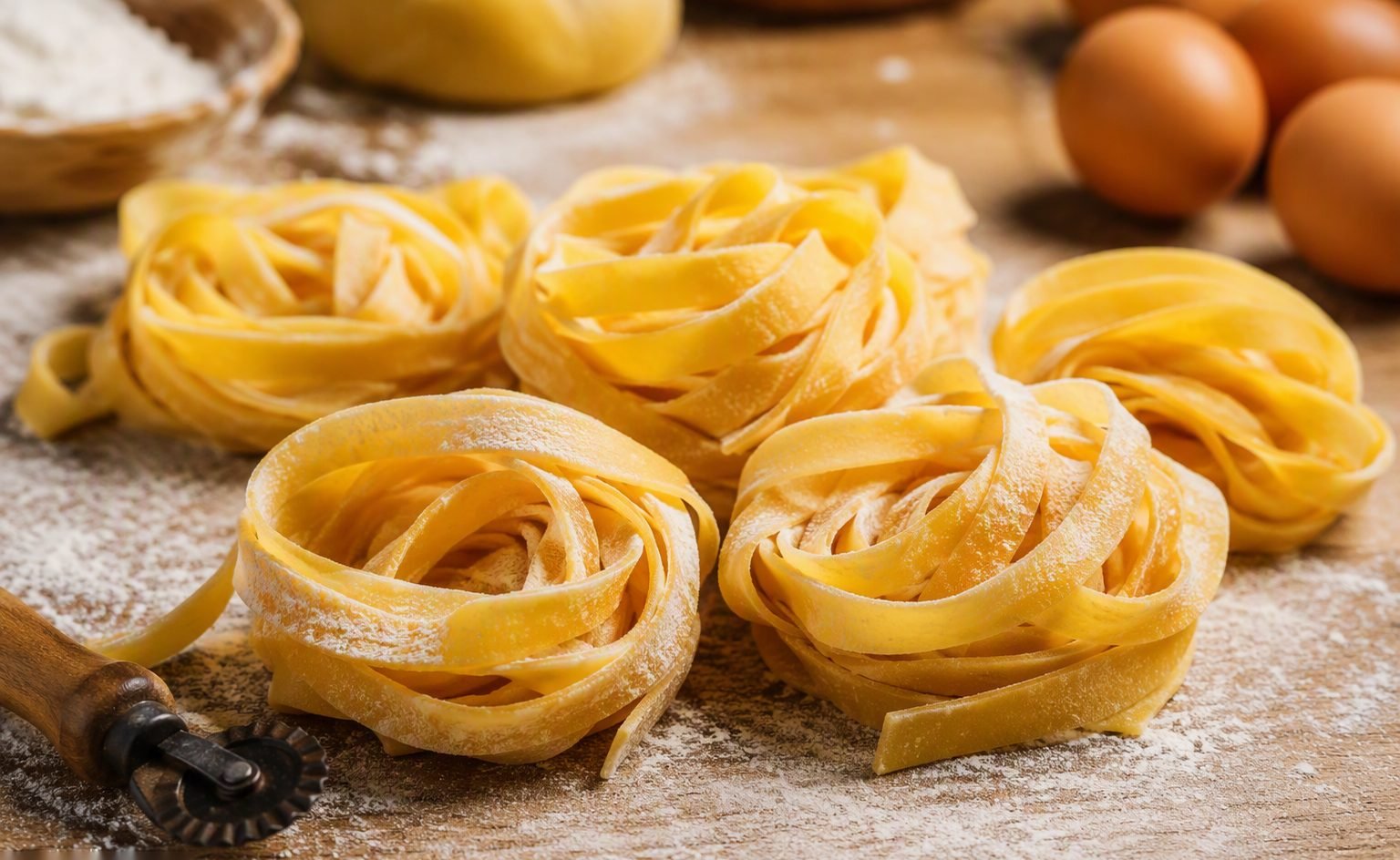
The application: egg pasta
Pasta divides into two broad worlds: durum semolina-and-water pasta — the backbone of the global category, containing no egg at all — and egg pasta, the enriched tradition behind tagliatelle, fettuccine, pappardelle and filled pastas. This guide covers the second world: what egg contributes to pasta dough, how format choices play out in production, and what to verify when sourcing. It does not imply every pasta product needs egg — most of the world's pasta is made without it, and that is entirely correct for those products.
Egg pasta lives across fresh, chilled and dried product forms, from artisan producers to industrial lines. The egg questions are common to all of them. For noodles — a distinct category with its own dough logic — see the noodles application guide; for the buyer-side view, the pasta & noodles industry page.
Where egg ingredients fit in pasta formulation
Egg transforms pasta dough in four visible ways. Colour: yolk carotenoids deliver the warm golden hue that signals egg pasta to consumers — colour intensity tracks yolk content directly. Flavour: the rich, distinctive taste that distinguishes egg pasta from semolina-water products. Dough characteristics: egg proteins and fat modify dough elasticity and sheeting behaviour, contributing the supple, workable dough egg-pasta production depends on. Cooking quality: egg contributes to the firm-yet-tender bite and the sauce-carrying surface the category is loved for.
Filled pastas — ravioli, tortellini and their relatives — lean particularly hard on dough quality, because the sheet must stretch, seal and survive cooking without failure. Egg content is also frequently a declared, regulated attribute: many markets define minimum egg content for products sold as "egg pasta," making accurate egg-solids accounting a compliance matter, not just a formulation one.
Direct-answer: what does egg do in pasta?
It defines the egg-pasta category: golden colour from yolk pigments, rich flavour, elastic workable dough, and the cooking quality consumers expect. Egg powder delivers these contributions in dry-store format — with the caveat that declared egg content must match actual egg solids in the finished product.
Which Egg Ingredient May Fit?
Potentially relevant ingredients for evaluation include Whole Egg Powder, Egg Yolk Powder and Liquid Whole Egg. Final ingredient selection depends on formulation, process and customer requirements.
Egg products for pasta production
Whole Egg Powder
The standard egg-pasta ingredient — balanced protein and yolk for colour, flavour and dough character in dry format.
View product → SpecialistEgg Yolk Powder
For colour-forward and extra-rich pasta recipes where yolk's pigment and fat lead the product design.
View product → AlternativeLiquid Whole Egg
Pasteurised, chilled — for fresh-pasta producers whose process is built on liquid handling. [PRODUCT AVAILABILITY TO BE CONFIRMED]
View product →Functional considerations in pasta dough
- Colour — yolk carotenoids deliver category-defining gold; colour is the most immediate visual check on egg dosage and consistency.
- Dough rheology — egg modifies elasticity and extensibility; sheeting, extrusion and forming behaviour all respond to egg level and format.
- Moisture balance — egg contributes water as well as solids; converting between formats means rebalancing dough water precisely.
- Protein contribution — egg proteins complement semolina proteins in the dough matrix, influencing cooking quality and bite.
- Flavour — egg's characteristic richness is a defining sensory attribute of the category.
- Declared content compliance — egg solids in the finished product must reconcile with label declarations and any market definitions of "egg pasta."
Formulation considerations
The declaration arithmetic comes first. Where your market defines egg pasta by egg content, work backward from the declared target: egg powder's solids contribution per unit weight, multiplied through the recipe, must meet the requirement in the finished product as sold. Our compositional documentation supports your calculation — confirmed values publish with the TDS [SPECIFICATION TO BE CONFIRMED] — but the compliance determination belongs to your regulatory team.
Format conversion is water arithmetic plus validation. Powder replaces liquid egg at the TDS reconstitution ratio, with dough water adjusted to hold absorption. Then validate: colour, sheeting behaviour, cooking quality. Dough systems differ in sensitivity — fresh sheeted pasta responds differently from extruded dried formats — so validate in your own process.
Dry-ingredient handling suits pasta plants. Egg powder doses with the dry ingredients, matching the dry-handling logic of semolina systems — no liquid-egg hygiene management, no refrigerated storage, no shell-egg variability. Consistent powder composition removes one drift source from dough consistency.
Processing considerations
Watch the interaction points: mixing (powder dispersion and dough development), sheeting or extrusion (dough rheology at the die or rollers), drying for dried pasta (colour and quality through the drying curve), and pasteurisation for fresh pasta. Egg format changes touch dough water first, then everything downstream of it. Your process parameters remain yours; these are the variables to monitor in conversion trials.
Powder vs liquid vs fresh in pasta production
Powder aligns with pasta plants' dry-ingredient world: dry-store logistics, precise dosing with semolina, long shelf life, and composition consistency for standardised dough. Liquid egg suits fresh-pasta operations built around liquid handling — no rehydration, direct metering, cold-chain costs attached. Fresh shell egg persists in artisan production, where its romance outweighs its operational costs; at industrial scale it rarely justifies itself.
For dried pasta especially, powder's dry-logistics fit is almost structural — the whole plant is a dry-ingredient operation. But the choice remains operational, not ideological: validate the dough and the finished product in your own system, whichever format you choose.
Procurement considerations
- Specification — written composition parameters per batch; the foundation of your declaration arithmetic.
- COA per batch — composition and micro results feeding your compliance records.
- Compositional documentation — supporting declared egg content in your markets.
- Micro standards — validated pasteurisation; request the supporting documents.
- Packaging — [PACKAGING TO BE CONFIRMED]; sizes matched to batch usage.
- MOQ & shelf life — [ACTUAL MOQ]; shelf life per TDS [SPECIFICATION TO BE CONFIRMED].
- Storage & shipping — dry, cool, sealed; dry-cargo freight — [TO BE CONFIRMED] per order.
Quality & food safety: what to evaluate
Pasta producers should evaluate suppliers on pasteurisation validation and micro discipline first, then on the consistency that keeps dough and colour stable: composition, carotenoid-driven colour, and flavour across lots, verified in your own production. Traceability and batch records complete the assessment.
Our approach is described on the quality page. Certifications remain [CERTIFICATION TO BE CONFIRMED] until verified documents are published.
Pasta application questions
It defines egg pasta: golden colour from yolk carotenoids, rich flavour, elastic and workable dough, and the cooking quality the category is known for. Egg proteins complement semolina proteins in the dough matrix.
No — most of the world's pasta is durum semolina and water, with no egg at all. Egg pasta is a distinct, enriched category (tagliatelle, fettuccine, filled pastas and similar). This guide covers that category specifically.
Yes — whole egg powder or yolk powder dose with the dry ingredients, with dough water adjusted per the TDS reconstitution ratio. Colour, sheeting behaviour and cooking quality should be validated in your own process when converting.
From the powder's egg-solids contribution per unit weight, multiplied through the recipe to the finished product as sold. Our compositional documentation supports the arithmetic; your regulatory team confirms compliance with your market's definitions. Confirmed values publish with the TDS [SPECIFICATION TO BE CONFIRMED].
Yolk carotenoids drive pasta colour in powder format as in fresh — colour intensity tracks yolk dosage. Verify colour in trials when converting formats, since drying and process conditions also influence the final hue.
Egg modifies dough elasticity and extensibility, influencing sheeting, extrusion and forming behaviour. Format changes alter dough water first — rebalance absorption, then validate handling at your die or rollers.
Written specification, COA per batch, compositional documentation supporting declarations, validated pasteurisation and micro standards, and colour and flavour consistency across lots.
Cool, dry, sealed — the same dry-store regime as semolina. Reseal opened packs promptly; reconstituted egg (where pre-rehydration is used) is perishable.
[ACTUAL MOQ] — MOQ depends on packaging and delivery location and is confirmed per enquiry. Samples are available for dough trials.
Producing egg pasta?
Share your product forms, process and volumes — we respond with specs, samples and pricing.