Using Egg Ingredients in Noodle Production
Colour, flavour and bite — how egg works in noodle dough systems, from fresh egg noodles to instant formats.
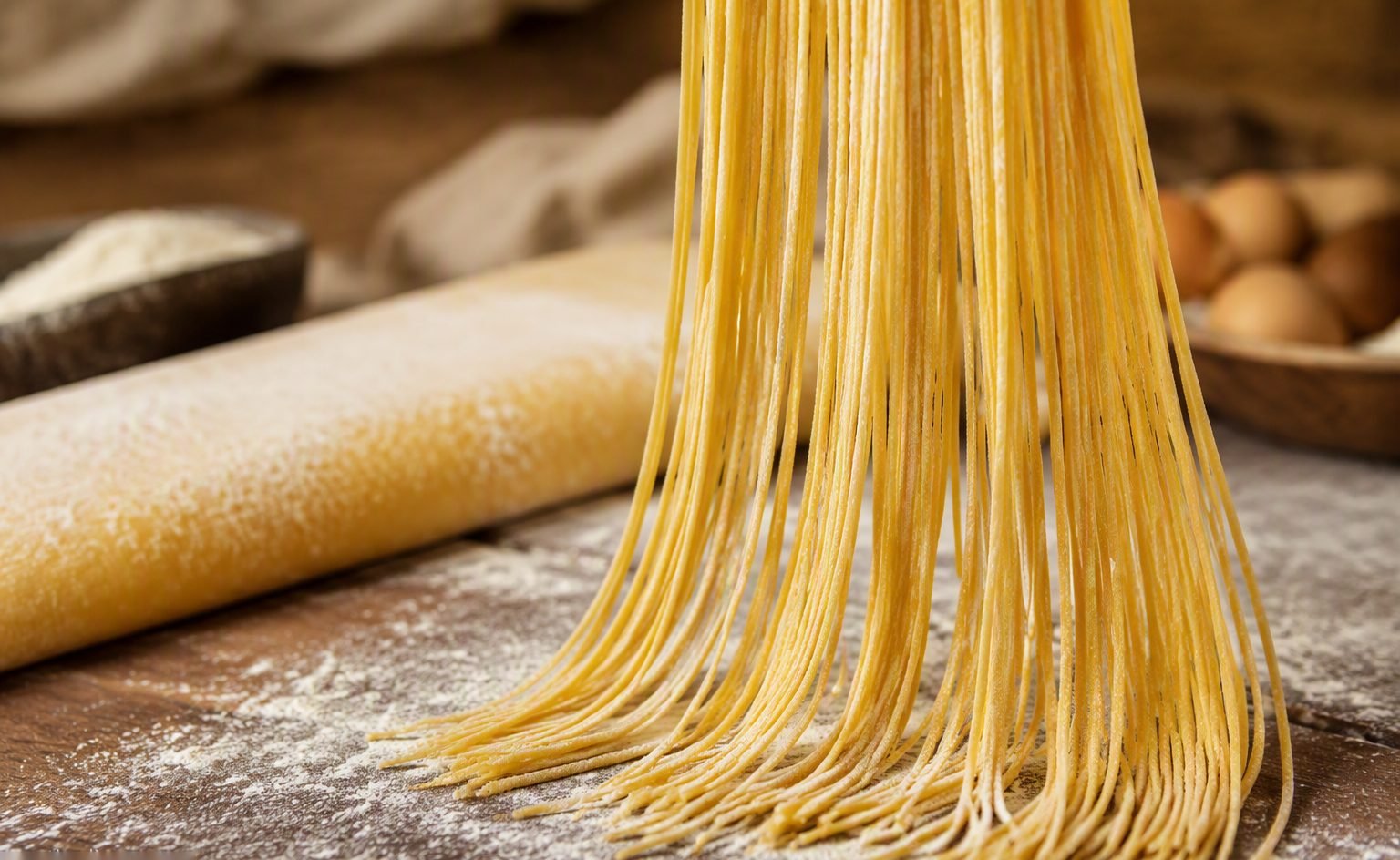
The application: egg noodles
Noodles are a distinct world from pasta — different flours, different dough chemistry, different processing, different culinary expectations. Within that world, egg noodles form a recognised sub-category: products where egg contributes colour, flavour and textural character, from Asian-style wheat noodles to Western egg noodle ribbons and instant noodle formats. This guide covers egg's role in noodle systems specifically — deliberately not repeating the pasta guide, whose semolina-based dough logic does not transfer directly.
Noodle production spans fresh, dried, steamed and fried-instant formats at very large scale. For the buyer-side view of the category, see the pasta & noodles industry page.
Where egg ingredients fit in noodle formulation
Noodle doughs are typically lower-moisture, higher-pressure systems than pasta doughs, built on wheat flour (often with salt or alkaline agents depending on the noodle type) and developed through sheeting and compounding rather than extrusion. Egg enters this system primarily for three contributions.
Colour is the most visible: the yellow hue consumers read as "egg noodle" comes substantially from yolk carotenoids — though note that alkaline noodles also derive yellow tones from flour-alkali reactions, and the two colour systems should not be confused. Flavour follows: egg adds the rich, savoury note associated with egg noodle products. Texture rounds out the trio: egg proteins interact with the gluten matrix during sheeting and cooking, contributing to the firm, springy bite egg noodles are expected to deliver. Egg's fat content also subtly modifies dough handling at the sheeter.
In instant noodles, egg appears in premium-positioned blocks where its colour and flavour support the product's positioning — the frying or hot-air drying process then locks in whatever the dough delivered.
Direct-answer: what does egg do in noodles?
It colours, flavours and firms: golden colour from yolk pigments, characteristic savoury richness, and protein contributions to the firm bite of egg-positioned noodle products. Egg powder delivers these with dry-store logistics and consistent composition across production runs.
Which Egg Ingredient May Fit?
Potentially relevant ingredients for evaluation include Whole Egg Powder, Egg Yolk Powder and Liquid Whole Egg. Final ingredient selection depends on formulation, process and customer requirements.
Egg products for noodle production
Whole Egg Powder
Balanced protein and yolk for egg noodle colour, flavour and texture — doses with the flour phase in dry format.
View product → SpecialistEgg Yolk Powder
For colour-forward recipes where maximum golden hue per unit of egg solids leads the product design.
View product → AlternativeLiquid Whole Egg
Pasteurised, chilled — for fresh-noodle operations built on liquid handling. [PRODUCT AVAILABILITY TO BE CONFIRMED]
View product →Functional considerations in noodle systems
- Colour systems — distinguish yolk-carotenoid yellow from alkali-reaction yellow; the two behave differently in formulation and in the finished product.
- Texture and bite — egg proteins interact with gluten through sheeting and cooking, contributing firmness and springiness; dosage and flour quality interact here.
- Dough handling — egg modifies sheeting behaviour and surface character at the rollers; low-moisture noodle doughs feel small formulation shifts.
- Flavour — egg's savoury richness is part of the category's identity; it survives steaming and frying better than many flavour systems.
- Processing survival — in instant formats, colour and flavour must survive steaming and frying or hot-air drying; validate the finished block, not just the dough.
- Declared content — where products claim egg content, egg-solids accounting must reconcile with the declaration in the finished product.
Formulation considerations
Dose with the flour phase. Egg powder disperses through the dry ingredients before water addition — matching noodle plants' dry-handling logic and avoiding liquid-egg hygiene management entirely. Water addition adjusts per the TDS reconstitution ratio [SPECIFICATION TO BE CONFIRMED]; noodle doughs are low-moisture systems where small water shifts matter, so the rebalance deserves precision.
Colour is a dosage-and-process outcome. Yolk level sets the colour potential; sheeting, steaming and drying decide how much of it reaches the finished noodle. When converting formats or adjusting egg levels, evaluate colour on the finished product through the full process — dough colour is a poor proxy.
Texture development is a system property. Flour protein quality, salt or alkaline agents, sheeting work and cooking all interact with egg's protein contribution. Trials should measure the attributes your product is judged on — bite, springiness, cooking loss — not just dough behaviour.
Processing considerations
Noodle lines are sheeting systems: compound rollers, reduction passes, cutting, then steaming and drying or frying for instant formats. Egg format changes touch dough water and rheology at the rollers first; downstream, colour and flavour development through thermal steps deserve measurement. Your process parameters remain yours — these are the points to watch when qualifying a new egg source or format.
Powder vs liquid vs fresh in noodle production
Powder fits noodle plants structurally: dry dosing with flour, dry-store logistics, long shelf life for the category's production planning, and composition consistency across the long runs instant-noodle production depends on. Liquid egg appears in fresh-noodle operations with liquid handling infrastructure. Fresh egg belongs to artisan noodle-making, not industrial scale.
At instant-noodle scale — very high throughput, very long runs — powder's consistency and logistics advantages compound. But the honest rule holds: no format is universally superior, and the finished-block evaluation in your own process is the only ranking that counts.
Procurement considerations
- Specification — written composition parameters per batch; consistency across long production runs begins here.
- COA per batch — composition and micro results for your QC records.
- Micro standards — validated pasteurisation; request supporting documentation.
- Packaging — [PACKAGING TO BE CONFIRMED]; formats suited to high-throughput dosing.
- MOQ & shelf life — [ACTUAL MOQ]; shelf life per TDS [SPECIFICATION TO BE CONFIRMED].
- Storage & shipping — dry, cool, sealed; dry-cargo freight — [TO BE CONFIRMED] per order.
Quality & food safety: what to evaluate
Evaluate suppliers on pasteurisation validation and micro discipline, then on the consistency that long noodle runs depend on: composition, colour potential and flavour across lots, verified on your own line. Batch records and traceability complete the assessment.
Our approach is described on the quality page. Certifications remain [CERTIFICATION TO BE CONFIRMED] until verified documents are published.
Noodles application questions
It colours (golden hue from yolk carotenoids), flavours (savoury richness) and firms (protein contributions to bite and springiness) in egg-positioned noodle products — from fresh egg noodles to premium instant blocks.
Not always. Alkaline noodles develop yellow tones from flour-alkali reactions without any egg. Egg-derived yellow comes from yolk carotenoids. The two colour systems are distinct and should not be conflated in formulation or in claims.
Yes — egg powder doses with the flour phase in premium egg-positioned blocks. Colour and flavour must be validated on the finished block through steaming and frying or hot-air drying, not just in the dough.
Egg proteins interact with the gluten matrix through sheeting and cooking, contributing to the firm, springy bite of egg noodles. Texture is a system property — flour quality, salts or alkaline agents, and process all interact with egg dosage.
With the dry ingredients before water addition — matching the plant's dry-handling logic. Water adjusts per the TDS reconstitution ratio; low-moisture noodle doughs are sensitive to small water shifts, so rebalance precisely [SPECIFICATION TO BE CONFIRMED].
Yes — egg modifies sheeting behaviour and surface character at the rollers. Format changes (liquid to powder) alter dough water first; rebalance absorption, then validate handling through your reduction passes.
Written specification, COA per batch, validated pasteurisation and micro standards, composition consistency across lots (critical for long runs), and colour and flavour performance on your own line.
Long ambient shelf life compared with liquid egg — supporting the production planning of high-throughput noodle operations. Confirmed values publish with the technical data sheet [SPECIFICATION TO BE CONFIRMED].
[ACTUAL MOQ] — MOQ depends on packaging and delivery location and is confirmed per enquiry. Samples are available for line trials.
Producing noodles?
Share your noodle types, process and volumes — we respond with specs, samples and pricing.