Product guide · Comparison
Egg Powder vs Fresh Eggs: An Honest Comparison
Ten dimensions, both sides argued fairly — including the cases where we would tell you to stay on shell eggs.
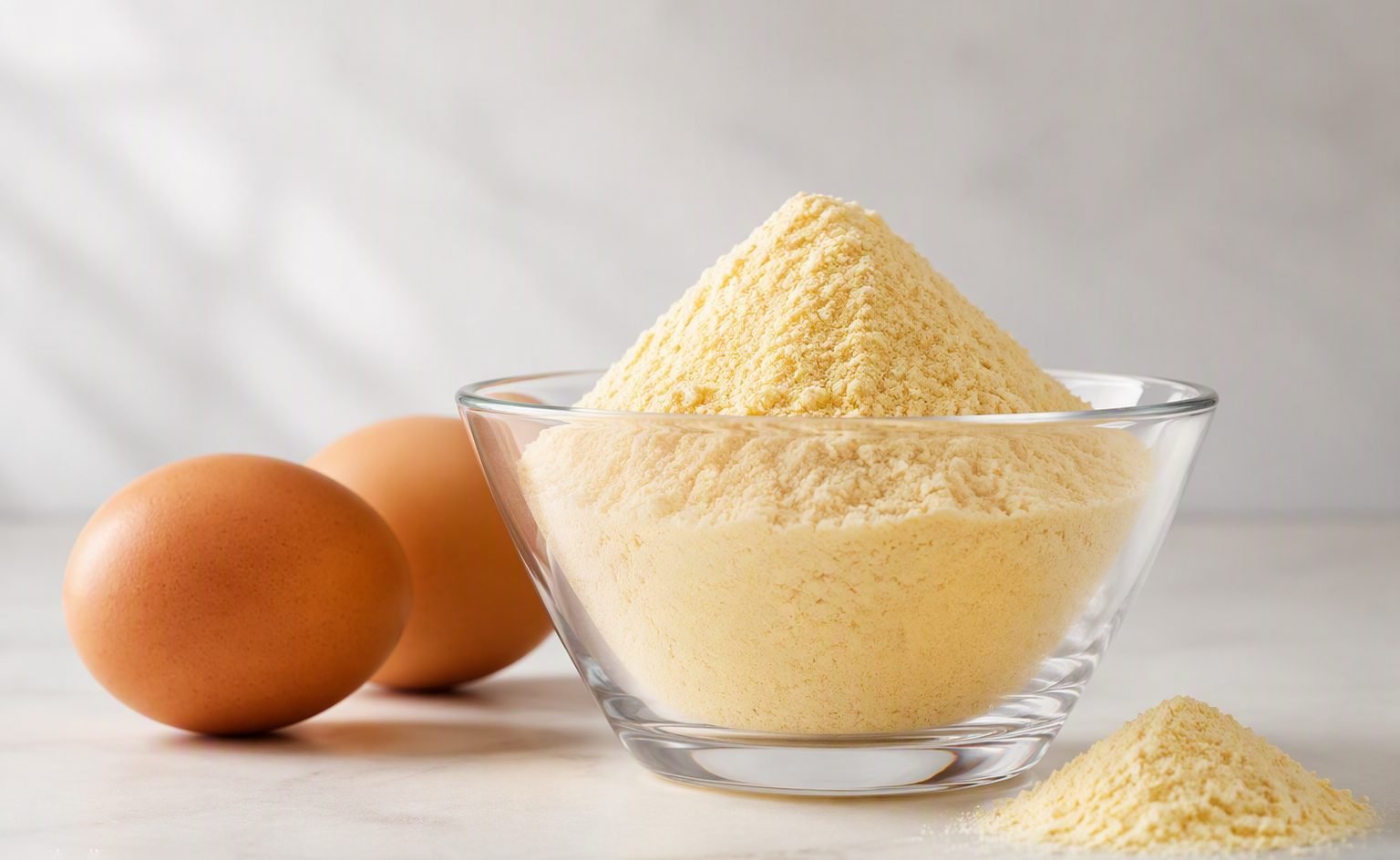
Still defining the ingredient? Read what is egg powder? first — this comparison assumes the basics.
Why this comparison exists
Most comparisons of egg powder and fresh eggs are written by someone selling one of them. Sahya Agro manufactures egg powder — so we have written this one with a deliberate discipline: every advantage of powder is stated alongside the condition that makes it true, and the cases where shell eggs remain the better choice are named explicitly. If you finish this guide and conclude your operation should stay on shell eggs, that is a valid outcome.
Handling
Fresh eggs arrive fragile, require breaking (manual or automated), generate shells as waste, and carry a raw-egg hygiene burden into the breaking area. Powder arrives as an ingredient: open, weigh, hydrate. No breaking, no shells, no raw-egg splash zone. The trade-off: powder adds a reconstitution step and demands moisture discipline in storage, which fresh eggs do not.
Storage
Fresh eggs need cool, careful storage and move through stock quickly. Egg powder stores at ambient warehouse conditions with a far longer usable life — the exact figure is product- and packaging-specific, stated on the specification: [PRODUCT-SPECIFIC SHELF LIFE TO BE CONFIRMED]. Powder's storage demand is dryness and pack integrity, not refrigeration; the storage guide covers it.
Transportation
Shell eggs move in fragile stacks, often refrigerated, with breakage losses priced in. Powder ships dense, ambient and robust — a particular advantage over long distances and across borders, where refrigerated logistics for liquid or shell egg is expensive or impractical. For import routes, powder is usually the only realistic egg format; see the import-export guide.
Consistency
Egg composition varies with season, flock and feed. Industrial powder production blends and standardises within specification limits, so each batch performs like the last — the property production planners value most. Consistency is verified per batch via the COA; see our COA policy. Fresh eggs offer no batch documentation at all.
Production planning
Powder's long shelf life decouples purchasing from production: you can hold safety stock, buy against price windows and survive supply interruptions. Fresh egg purchasing is effectively just-in-time, exposed to price spikes and availability shocks — a real risk in markets with volatile egg supply.
Shelf-life considerations
This is powder's structural advantage, stated with its one condition: the advantage is only as real as the stated shelf life on the specification and your storage discipline. We do not publish generic numbers — Sahya Agro's shelf life is [PRODUCT-SPECIFIC SHELF LIFE TO BE CONFIRMED] — and any supplier quoting shelf life without reference to packaging and storage conditions is quoting marketing, not shelf life.
Labor
Breaking eggs is labour: manual cracking, or capital and maintenance for breaking machines, plus cleaning and shell disposal. Powder removes that labour and its hygiene overhead, replacing it with weighing and hydration — a smaller, cleaner task. For small kitchens the arithmetic can still favour shell eggs; for industrial lines it rarely does.
Formulation
Powder doses by exact weight, slots into dry premixes, and allows separate purchase of white and yolk functionality — formulation options fresh eggs cannot offer. Reconstitution is straightforward but must be validated; see how to use egg powder. Where fresh eggs retain an edge: certain delicate culinary foams and custards, and recipes where the chef's process is built around fresh eggs and volumes are small. Reformulating such products to powder is possible but must be proven, not assumed.
Logistics and space requirements
One pallet of egg powder replaces many times its volume in shell eggs, needs no cold room, and frees refrigerated space for other ingredients. For urban factories where cold storage is the constraint, this alone can decide the format question.
Where fresh eggs still win
- Small-batch artisan production with reliable local egg supply and no storage pressure — the infrastructure for powder may not pay back.
- Specific culinary textures and foams where a formulation has never been validated with powder and the product's identity depends on it.
- Markets where shell eggs are exceptionally cheap and logistics short — the cost-in-use gap can narrow or reverse.
And one honest caution in the other direction: switching to powder to escape a hygiene problem, without fixing storage and reconstitution discipline, trades one risk for another.
How to decide for your operation
Score your operation on the ten dimensions above with real numbers: your volumes, your cold-storage cost, your labour rate, your waste, your supply volatility. Then run the decisive test — a cost-in-use calculation per kilogram of finished product, including waste, labour, energy and risk, on both formats. Where powder wins on paper, validate with samples before converting; the buying guide structures that process.
Practical takeaways
- No universal winner. Scale, infrastructure and formulation decide the format — this guide gives both sides their due.
- Powder's edge is logistical. Storage life, ambient transport, dosing consistency and planning resilience — all conditional on storage discipline.
- Fresh keeps culinary niches. Small batches and un-validated delicate foams can justify staying on shell eggs.
- Decide on cost-in-use. Include waste, labour, energy, cold storage and supply risk — then sample before you convert.
Answers
Powder vs fresh: FAQ
Neither is universally better. Powder wins on shelf life, ambient logistics, consistency and production planning; fresh eggs win for small batches, certain culinary foams and where local supply is cheap and reliable. Decide on your scale, process and cost-in-use — then validate with samples.
Properly processed and stored egg powder reconstitutes into functional egg, and manufacturers use it in products where flavour matters. But flavour is application-specific — validate in your own product rather than trusting any general claim, including ours.
Commercial egg powder is pasteurised during production, and batch testing is documented per delivery via the COA. As with any ingredient, safety in use depends on supplier verification, storage discipline and your own hygiene controls — see our quality pages for how we document this.
There is no honest universal conversion — it depends on the product and the application. Any starting ratio is an illustrative starting point only and must be validated against the product specification and your recipe. The usage guide explains the method.
No — ambient warehouse storage is a core advantage, provided conditions are dry and packaging stays intact. Exact storage conditions are product-specific and stated on the specification; see the storage guide.
Far longer — that is the format's structural advantage. The exact figure is product- and packaging-specific: [PRODUCT-SPECIFIC SHELF LIFE TO BE CONFIRMED]. We do not publish generic shelf-life numbers, and neither should any serious supplier.
Compare cost-in-use, not price per kilogram: include waste, breaking labour, refrigeration, transport and supply risk. Powder often wins at industrial scale; fresh eggs can win where they are exceptionally cheap and volumes are small.
Usually yes, with reformulation and validation. Dosing, hydration and process adjustments need proving in trials — never convert on the basis of a datasheet. Start with the usage guide and production-representative samples.
Bakery and premixes, biscuits, confectionery, noodles and pasta, mayonnaise and sauces, and general food processing — see the industries section for how each uses egg ingredients.
Work with us
Run the numbers with real samples.
Request production-representative samples and test the format question in your own process.