Egg Ingredients for Sauce Manufacturers
Emulsified sauces, cream systems, dressings and dry mixes all lean on egg for body and stability — often through thermal processes that punish weaker formulations. Here is how sauce producers buy egg well.
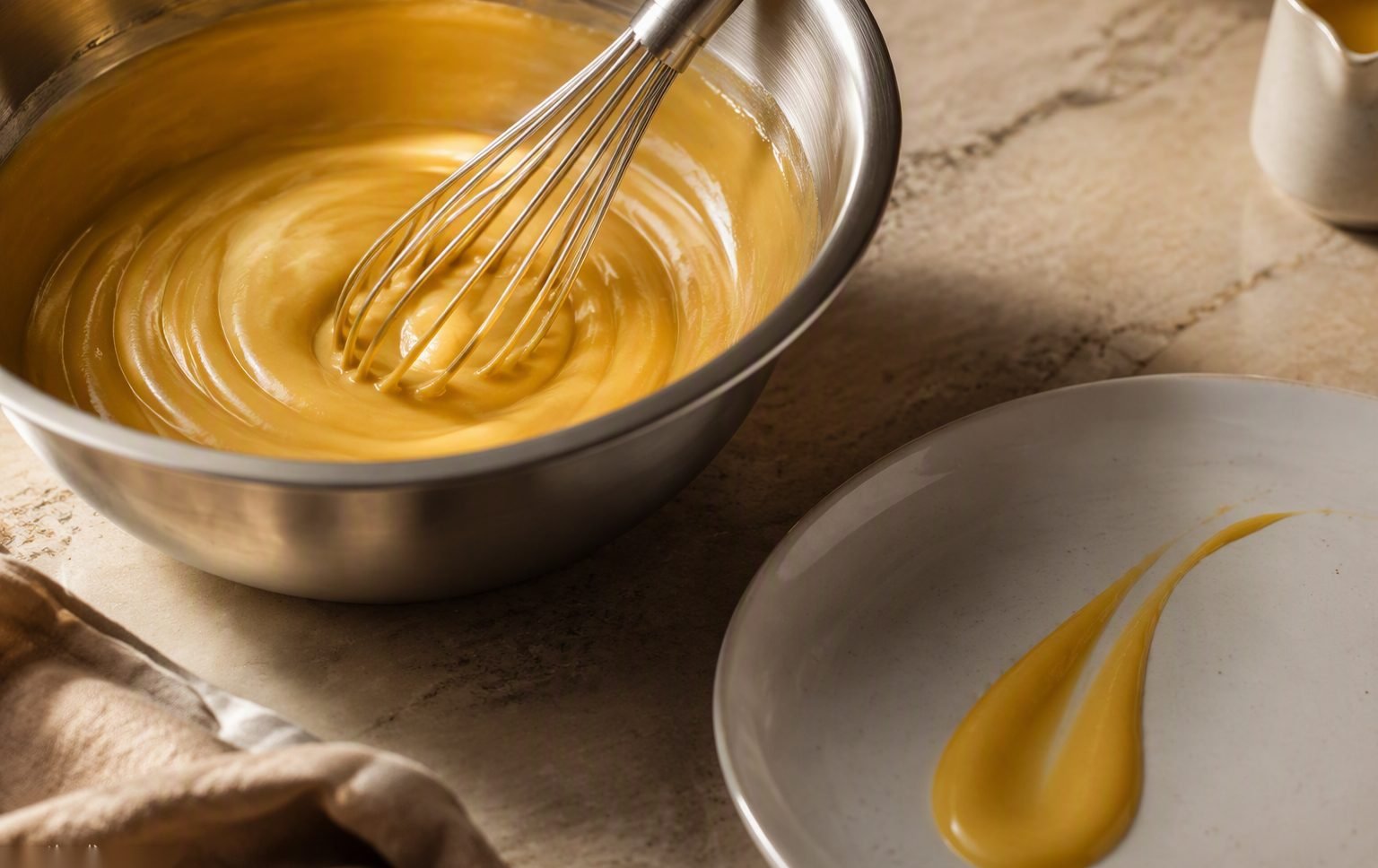
The sauce industry's ingredient reality
"Sauces" covers more ground than almost any other food category: shelf-stable mayonnaise-style dressings, chilled emulsified sauces, retorted cream sauces, gravies, ready-meal components, and the dry mixes that reconstitute into all of the above. What unites them is a structural problem — keeping fat, water and flavour unified through processing, distribution and reheating — and egg, particularly yolk, has been solving versions of that problem since classical cuisine invented the emulsified sauce.
Industrial sauce making adds stresses the classical kitchen never faced: hot-fill and retort temperatures, months of ambient shelf life, freeze-thaw cycles in frozen ready meals, and microwave reheating by the end user. Formulations survive these stresses as systems — emulsifier, starch, hydrocolloid, process — and egg's role inside those systems is valued for what it uniquely combines: emulsification, body, rich flavour and a clean label. This guide covers where egg ingredients fit, which formats suit which sauce operations, and what procurement teams should verify.
From Industry Requirement to RFQ
1 · Industry requirement
Typical need: emulsification and richness in sauces, dressings and gravies. Define your process conditions, volumes and destination before selecting an ingredient.
2 · Relevant egg ingredients
Potentially relevant ingredients for evaluation: Egg Yolk Powder, Liquid Egg Yolk, Whole Egg Powder. Final selection depends on formulation, process and customer requirements.
3 · Technical information
Review the buyer specification summary and the specification guide; product specifications are provided per product on request.
4 · RFQ
Share your requirement, destination and documentation needs through the RFQ form — or request a sample first.
Where egg ingredients fit in sauce formulations
In emulsified sauces — hollandaise-style, béarnaise-style, butter sauces, dressings — yolk is the structural foundation, coating oil droplets and holding the emulsion just as it does in mayonnaise, usually at lower oil levels and often alongside starch. In cream and cheese sauces, yolk plays a supporting role: enriching mouthfeel, rounding flavour and helping the system stay unified through heating and holding. In gravies and ready-meal sauces, whole egg or yolk contributes body and the home-made flavour notes consumers reward.
Dry sauce mixes are a special case that deserves emphasis: hollandaise mixes, custard bases, cheese-sauce powders and gravy systems can only be built from shelf-stable ingredients. Yolk and whole egg powders bring egg functionality into this format at all — there is no liquid alternative.
Direct-answer: why do sauce manufacturers consider egg powder?
Because sauce production punishes inconsistency with visible defects — separated emulsions, thin body, dull flavour. Powder delivers identical emulsifying strength and composition in every batch, stores without refrigeration, and is the only egg format that works in dry mixes. The dispersion step it requires fits naturally into existing aqueous-phase preparation.
Sahya Agro products for sauce production
Egg Yolk Powder
Emulsification, body and rich flavour for emulsified sauces, dressings, cream systems and hollandaise-style products.
View product → PrimaryWhole Egg Powder
Balanced thickening and whole-egg flavour for sauce mixes, gravies, ready-meal components and custard-style systems.
View product → AlternativeLiquid Egg Yolk
Pour-and-mix yolk for high-throughput sauce plants within cold-chain range. Availability [PRODUCT AVAILABILITY TO BE CONFIRMED].
View product →Application breakdown by sauce type
Emulsified sauces and dressings
Hollandaise-style and béarnaise-style sauces, buttery dressings and mayonnaise-adjacent systems rely on yolk as primary emulsifier. Powder disperses into the aqueous phase before oil incorporation; the emulsion then behaves as any yolk emulsion does. Consistency of the emulsifier is what allows the rest of the process — oil rate, shear, temperature — to run on settings rather than constant adjustment.
Cream, cheese and dairy-based sauces
In dairy-based systems, yolk enriches and supports the existing emulsion rather than carrying it alone. It rounds the flavour of cheese sauces, adds velvety weight to cream sauces, and helps béchamel-style systems feel like cooking rather than chemistry. Dosage is typically modest — which makes consistency per gram matter more, not less.
Ready-meal and retorted sauces
Sauces destined for retort pouches, hot-fill jars or frozen ready meals face the harshest stability tests in the category. Egg-based emulsions are formulated as systems here — yolk plus starch plus process — and validated under the actual thermal profile. Powder's batch-to-batch uniformity means a validated formula stays validated.
Dry sauce and gravy mixes
The powder-only world: hollandaise mixes, sauce bases, custard powders and gravy systems where yolk or whole egg powder reconstitutes with the end user's water or milk. Flowability, dispersibility and shelf stability of the egg powder itself become purchasing criteria alongside functionality.
Foodservice sauce programs
Central kitchens producing sauces at scale use yolk and whole egg powders for the same reasons as factories, plus one more: predictable results with rotating kitchen labour, where a forgiving, standardised ingredient prevents expensive mistakes.
Functional considerations for sauce technologists
- Emulsification under your conditions — validate at your oil level, pH and shear, not in a neutral bench test.
- Thermal stability as a system property — retort and hot-fill survival depends on the whole formula; egg's contribution is consistency, not magic.
- Dispersion discipline — hydrate yolk powder fully in the aqueous phase before oil or high shear; trapped dry cores never emulsify.
- Flavour freshness — yolk lipids carry rich flavour; oxidation control through the supply chain protects it. Rotate stock FIFO.
- Freeze-thaw realism — frozen sauce stability needs the full stabiliser system; validate cycles in development trials.
- Reconstitution behaviour — for dry mixes, test how the powder disperses at end-user conditions (cold or warm liquid, hand whisk vs machine).
Powder vs liquid egg in sauce production
Sauce plants near production with chilled infrastructure and continuous throughput can run liquid yolk with minimal process change — it pours straight into the aqueous phase. Powder serves everyone else, plus two situations where it has no substitute: dry mixes, and any plant whose sauce production is intermittent enough that a short-life chilled ingredient would create waste. The shelf-life difference is strategic as much as operational: powder lets procurement hold buffer stock against supply interruptions, something a perishable liquid never allows.
Procurement guide for sauce manufacturers
- Functional data — emulsifying performance and dispersibility information, not just composition.
- COA per batch — matched to a written specification, with micro parameters for your category.
- Oxidation and freshness policy — yolk flavour depends on fat condition through drying, packaging and storage.
- MOQ and lead time — [ACTUAL MOQ]; align with your production calendar and buffer-stock policy.
- Packaging — [PACKAGING TO BE CONFIRMED]; barrier quality matters for fat-rich powders.
- Documentation — batch identity, traceability, allergen declaration, export papers where applicable.
- Process trials — validate under your actual thermal and shear conditions before volume.
Quality & food safety: what to evaluate
Sauce applications span ambient-stable, chilled and retorted products, so ingredient-level microbiological control matters across the board: pasteurisation validation, Salmonella standards, hygienic drying and packing, and rapid batch documentation. For retorted products, ingredient consistency is also a safety-adjacent issue — formulation validation assumes the ingredient you validated against is the ingredient you keep receiving.
Our approach is described on the quality page. Certifications remain [CERTIFICATION TO BE CONFIRMED] until verified documents are published.
Barrier formats
[PACKAGING TO BE CONFIRMED] — moisture and oxygen barriers protect both flowability and flavour.
Dry warehouse
Cool, dry, sealed storage with FIFO rotation; no refrigeration required for powder formats.
Dry cargo
Freight-friendly powder logistics; configurations confirmed per order — [TO BE CONFIRMED].
Export considerations for sauce manufacturers
Powder formats make sauce-ingredient sourcing geography-independent: dry cargo freight, long shelf life, batch COA and shipping documentation. Destination-specific requirements should be raised at enquiry. Verified destination list: [ACTUAL EXPORT MARKETS]. See our global supply page.
Sauce manufacturer questions
Egg yolk powder is the primary sauce ingredient — for emulsified sauces, dressings and rich cream systems. Whole egg powder appears in sauce-mix and ready-meal formulations where balanced thickening and egg flavour are wanted. Liquid yolk serves high-volume plants within cold-chain range.
Yolk emulsifies oil into the water phase, adds body and a velvety mouthfeel, contributes rich flavour and golden colour, and helps sauces hold together through thermal processing and reheating. It is the classic base of hollandaise-style and custard-adjacent sauce systems.
Egg-stabilised emulsions can be formulated to survive thermal processing, but stability depends on the full system — starch support, homogenisation, pH and process profile. Egg powder's advantage is consistency: once a formula is validated, the emulsifier behaves identically in every batch.
Yes — dry mixes are a powder-only format, since every ingredient must be shelf-stable and free-flowing. Yolk and whole egg powders provide the emulsification and richness that reconstitute when the end user adds water or milk.
Mayonnaise is a specific high-oil emulsion; the sauce category is broader — emulsified sauces, cream sauces, dressings, gravies and ready-meal components, often with lower oil, added dairy or starch, and harsher thermal processes. Egg's role shifts from primary emulsifier to emulsifier-plus-enricher.
Emulsifying performance data, fat freshness (oxidation control), microbiological standards, COA per batch, dispersibility in your process, packaging integrity, and pilot trials under your actual thermal process before volume commitment.
Freeze-thaw stability depends on the whole stabiliser system. Yolk's emulsification contributes, but frozen sauce formulations typically combine it with starches or gums. Validate freeze-thaw cycles in development trials rather than assuming any single ingredient carries stability.
Cool, dry and sealed with FIFO rotation — standard dry-ingredient practice. Yolk powder is fat-rich, so protection from heat and oxygen preserves flavour over storage.
[ACTUAL MOQ] — MOQ depends on packaging and destination and is confirmed per enquiry. Samples are available for process trials before any commercial order.
Yes — powder formats ship as dry cargo with batch COA and export documentation. Our verified export market list is to be confirmed; sauce manufacturers are welcome to enquire about their destination.
Producing sauces or dressings?
Share your product types, volumes and destination — we respond with specs, samples and pricing.